

Luxury Perfume vs Designer Fragrance: 2026 Comparison
Table of Contents
- What Counts as a Designer Fragrance?
- What Makes a Luxury Perfume Different?
- Luxury Perfume vs Designer Fragrance: Side-by-Side Comparison
- Designer Fragrance Longevity: What to Expect on Skin
- Is Luxury Perfume Worth It? Price Per Wear and Value
- How to Choose a Perfume for Your Skin and Style
- Luxury Perfume Gift Guide: Picking a Bottle for Someone Else
- Conclusion: Matching the Bottle to the Person
- Frequently Asked Questions
Last Updated: October 11, 2026
What Counts as a Designer Fragrance?
A designer fragrance is a scent released under a fashion or lifestyle house's name, created to sit alongside its clothing, handbags, and accessories.
That distinction matters because it shapes everything downstream, from who directs the scent to how widely it is sold.
Designer scents are built around broad appeal. A house with a flagship store and a seasonal collection needs a fragrance that flatters most people and offends almost no one.
At Lady Dawson, we approach scent differently, treating each composition as something closer to a memory than a product line.
What Makes a Luxury Perfume Different?
Luxury perfume is fragrance made by a house that exists to make fragrance, not to extend a fashion label. These houses, often called niche or artisanal, put creative direction first.
The difference shows up in the composition. A luxury scent often uses a denser structure, with more distinct notes unfolding over hours rather than minutes. Rare raw materials appear at higher concentrations.
Our own approach fits this model. Jubilée opens with lime, mandarin, and bergamot, moves through blue tansy, myrtle, and neroli, and settles into patchouli, vanilla, vetiver, and amber.

Luxury Perfume vs Designer Fragrance: Side-by-Side Comparison
The clearest way to see the split is to line up the two categories against the factors that actually affect what you wear, and to be honest about where the labels blur.
| Factor | Designer Fragrance | Luxury Perfume |
|---|---|---|
| Who makes it | Fashion or lifestyle house | Fragrance-focused house |
| Creative lead | Marketing brief, broad appeal | Perfumer's vision |
| Production scale | Large, mass market | Small batch, often limited |
| Distribution | Department stores, wide availability | Direct, selective retail |
| Typical concentration | Eau de toilette to eau de parfum (roughly 5-15% fragrance oil) | Often eau de parfum or extrait (roughly 15-30%) |
| Price per fluid ounce | Lower up front | Higher up front |
| Sampling cost | Free counter sprays, low-cost carded vials | Paid discovery sets, often $20-$60 for a curated sampler |
| Counterfeit exposure | High, popular bottles are widely faked | Lower volume, but still targeted online |
| Best use case | Everyday, office, gift-safe | Signature scent, evening, collector |
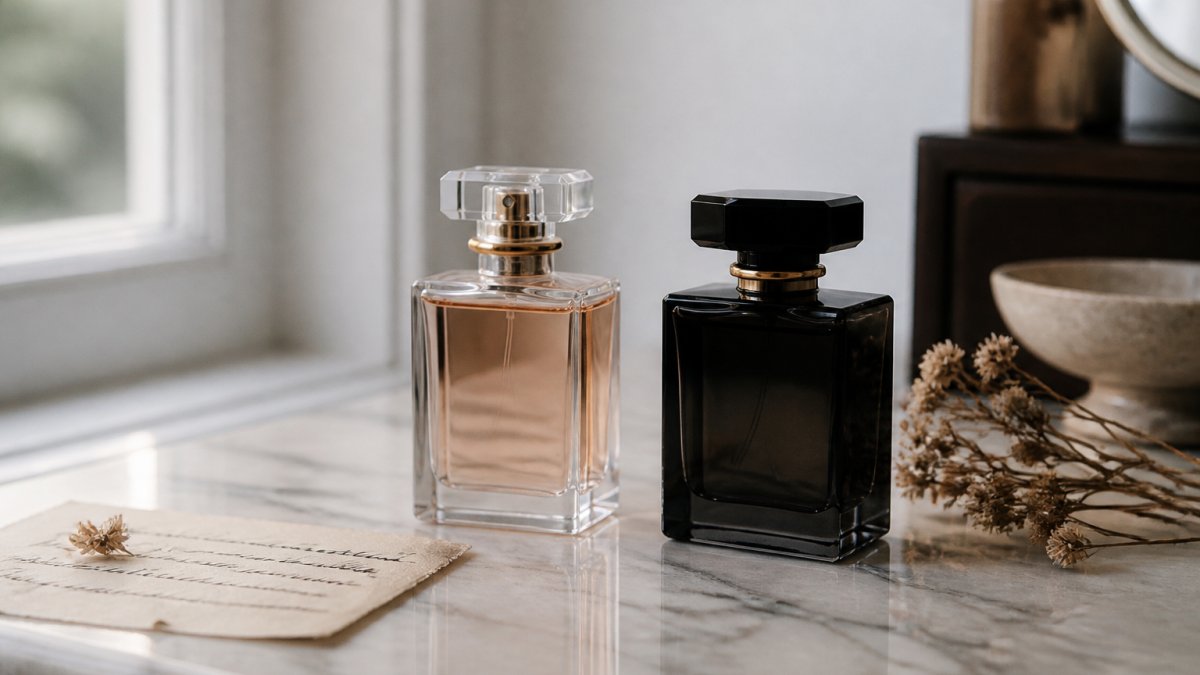
Where the categories overlap
The keyword sets up a clean binary, but the market does not cooperate. A fashion house can release a limited, high-concentration scent that behaves like a luxury perfume. A fragrance-focused house can put out a wide-distribution eau de toilette that behaves like a designer staple. The label on the box tells you who made it, not how it will wear.
A more useful way to sort any bottle is by three questions:
- Who directed the brief? A marketing team optimizing for broad appeal, or a perfumer working from an idea?
- How wide is the distribution? Every mall counter, or a short list of authorized retailers?
- What is the concentration and structure? A light, top-note-forward build, or a dense base that unfolds over hours?
Answer those and you have placed the bottle on the spectrum, regardless of what the brand calls itself.
The price-per-wear reality
Sticker price is the least useful number in fragrance. What matters is cost per wearing, which depends on bottle size, concentration, how many sprays you use, and how often you actually reach for it.
Run a simple comparison on your own shelf:
- A 50ml designer eau de toilette worn twice a week, two sprays per wear, lasts roughly six to nine months.
- A 50ml luxury eau de parfum worn the same way often lasts longer per wear because the base holds, so you may use fewer sprays and replace the bottle less often.
That does not automatically make the luxury bottle cheaper. It makes the comparison honest. A scent you love and wear three times a week beats a bargain bottle that sits untouched, every time.
Designer Fragrance Longevity: What to Expect on Skin
Designer fragrance longevity varies widely, and the number on the box rarely tells the whole story. Skin chemistry, concentration, and the notes themselves all shift how long a scent lasts. A citrus-forward designer spray may fade within a few hours. A heavier base of woods or resins can hold much longer.
Here is what tends to happen across a wear:
- First hour: Top notes dominate, and the scent reads brightest.
- Two to four hours: Middle notes take over as the top fades.
- Four hours onward: Base notes carry the dry-down, if the formula has enough weight.
Why the category label does not predict performance
A common claim in fragrance writing is that luxury perfume lasts longer than designer fragrance. That is not reliably true. Longevity is a function of four things, and price is not one of them:
- Concentration. An extrait (roughly 20-30% fragrance oil) will generally outlast an eau de toilette (roughly 5-10%) from the same house, regardless of price tier.
- Base-note weight. Formulas built on patchouli, oud, tonka, amber, or resins hold longer than those built on citrus and light florals.
- Skin chemistry. Oily skin tends to hold scent longer than dry skin. Body heat and pH shift how a fragrance reads from person to person.
- Application. Moisturized skin, pulse points, and a light spray distance all extend wear. Rubbing the wrists together crushes top notes and shortens the arc.
Most practitioners find that a well-constructed designer extrait outperforms a thin luxury eau de toilette, and vice versa. The formula, not the label, decides.
How to test longevity before you commit
Because performance is personal, the only reliable test is on your own skin, over a full day. A practical routine:
- Sample first. Request a carded vial at the counter, or buy a small decant. Wear it on one wrist and a known reference scent on the other.
- Check at three points. Note the scent at one hour, four hours, and eight hours. That tells you more than any marketing copy.
- Buy from authorized sellers. Counterfeit and diluted bottles are common in resale channels, and a fake will underperform the real thing, which can make you misjudge a whole house.
- Keep the receipt. Many retailers allow returns on unopened bottles within a set window; confirm the policy before you buy.
Is Luxury Perfume Worth It? Price Per Wear and Value
Whether luxury perfume is worth it comes down to price per wear, not the sticker price.
Run the math on your own habits. A 50ml bottle worn three times a week for a year works out to a small cost per wearing, spread across months of use.
Value also depends on what you want from the scent. If you want a pleasant everyday spray, a designer bottle does the job. If you want a signature that feels like yours, the extra cost buys originality, better materials, and a smaller production run.
How to Choose a Perfume for Your Skin and Style
Choosing a perfume starts with your skin, not the shelf. Oily skin holds scent longer than dry skin. Body heat, pH, and even the time of day change how a fragrance reads. The same bottle can smell different on two people.
Work through it in this order:
- Test on skin, never on paper alone. Paper shows the idea; skin shows the result.
- Wear it for a full day before deciding. Judge the dry-down, not the opening spray.
- Match the scent to the occasion. A bright citrus suits daytime; a warm floral or resinous base suits evening.
- Start with a small size. A 10ml lets you live with a scent before committing to a full bottle.
- Trust your reaction, not the trend. The one that makes you pause is usually the one.
For anyone new to fragrance, a small format is the smart entry point. Our Jubilee 10ml and Superbloom 10ml both let you test a full composition on your own skin before you buy the larger bottle.
Luxury Perfume Gift Guide: Picking a Bottle for Someone Else
A luxury perfume gift works best when it matches the person, not your own taste. Start with what they already wear and how they talk about it. Someone who loves fresh, bright scents will not thank you for a heavy oud. Someone who wears deep florals will not reach for a light citrus.
A few practical moves:
- Choose a small bottle first. A 10ml is a low-risk gift that still feels considered.
- Note their style. Classic and floral points one way; warm and grounding points another.
- Think about the occasion. A milestone calls for a full bottle; a thank-you suits a travel size.
- Include the story. A scent with a memory behind it lands harder than a logo.
For a floral-leaning recipient, Superbloom layers rose, orange flower, and honeysuckle over jasmine, lily, and rosewood, then grounds it with oud, tonka, nagarmotha, and benzoin. For someone who prefers warmth and freshness, Jubilée's citrus-and-amber arc is the safer, more universal pick.

Conclusion: Matching the Bottle to the Person
The designer-versus-luxury question has a real answer, but it is not about which is better in the abstract. It is about fit.
That is the work we do at Lady Dawson. We source and test fine essential oils and fragrance materials from around the globe, then build each composition to hold a memory rather than follow a trend.
If you have been circling the same mass-market shelf for years, start with a 10ml and see how it wears on your skin. Get started with Lady Dawson and find the scent that remembers you back.
Frequently Asked Questions
What is the difference between luxury perfume and designer fragrance?
Designer fragrance comes from fashion or lifestyle houses that also sell clothing, handbags, or accessories, and it is built to sell in large volumes through wide distribution. Luxury perfume, often from independent or artisanal houses, is made in smaller batches with more focus on creative direction, ingredient sourcing, and a distinct scent profile. The practical difference shows up in originality, production scale, price per bottle, and how closely the scent follows current trends.
Do luxury perfumes last longer than designer fragrances?
Not automatically. Longevity depends on concentration, base notes, and your skin chemistry more than on the label. A designer eau de parfum with heavy base notes like patchouli or oud can outlast a lighter luxury eau de toilette. When you compare, test both on skin and check how the scent develops after four to six hours rather than judging from the opening spray alone.
Is luxury perfume worth it compared to a designer bottle?
It depends on what you want from a scent. If you want a recognizable, widely available fragrance at a lower price per ounce, designer is a reasonable choice. If you want originality, smaller production runs, and a signature scent that fewer people around you wear, luxury perfume can justify the higher price. A useful test is price per wear: a $135 bottle worn three times a week for a year costs under a dollar per wearing.
How do I choose a perfume if I am new to fragrance?
Start with a small format rather than a full bottle. Lady Dawson offers 10ML sizes of Jubilee and Superbloom at $15, which lets you test how each scent develops on your skin over several days. Spray on pulse points, avoid rubbing, and note how the top, middle, and base notes shift across the day. Once one feels like yours, move up to the 50ML bottle at $135.
What should I look for in a luxury perfume gift?
Match the scent profile to the person rather than to trends. A citrus-and-amber composition like Jubilee suits someone who prefers fresh, grounding scents, while a floral with oud and tonka like Superbloom fits a warmer, more classic taste. A 10ML bottle at $15 works as a low-risk introduction, and the 50ML at $135 makes a stronger statement for a milestone occasion.